
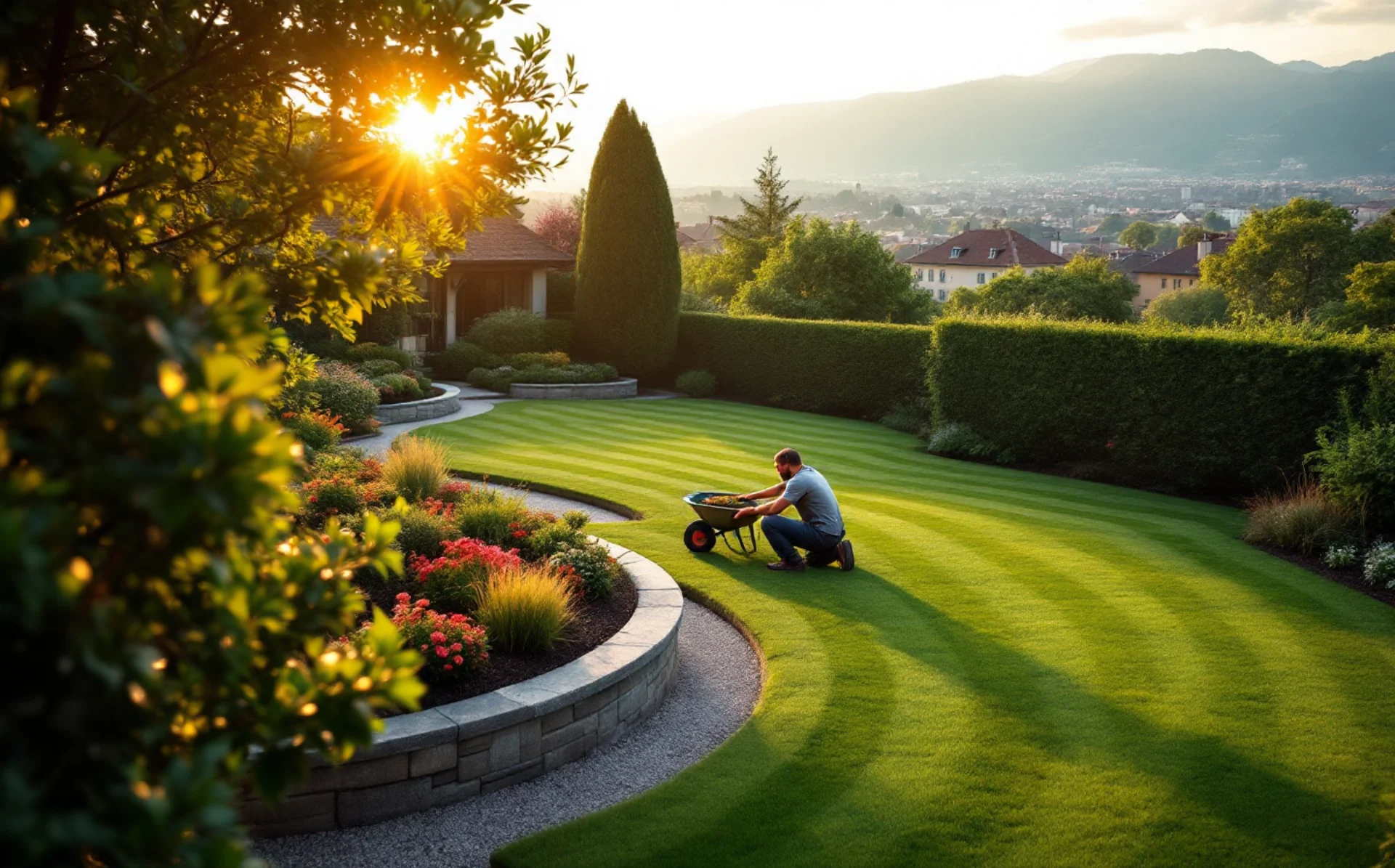
A landscaper in Veyrier works on plots where the terrain makes things demanding: slopes, walls to build, water to manage, terraces to lay. They design and carry out the complete landscaping of your outdoor space, from the structure to the planting. Describe your project online: a qualified landscaper will get back to you within 24 hours, visit the site and provide a free, no-obligation quote.
The land in Veyrier: what to know before a project
Veyrier lies on the left bank, at the foot of the Salève and beside the Arve. The commune includes Veyrier village, Vessy, Sierne and part of Pinchat. It is mostly made up of villa neighbourhoods, with many plots sloping down towards the Arve.
This topography shapes almost every project. A slope calls for retaining the soil, spreading the levels and draining rainwater away without weakening the ground or neighbouring plots. Geneva soils are often clay-rich: they hold water in winter and crack in summer. The Lake Geneva climate brings summers that can be dry, and the bise wind, which dries out exposed planting. Close to the Arve and the foot of the Salève, exposure and water run-off vary from one plot to the next, which is why a site visit is worthwhile before any quote.
Landscaping projects in Veyrier
Landscaping sloping land
Land that slopes down towards the Arve can become a usable garden provided it is structured in tiers. The landscaper designs levels, steps and paths, then chooses planting that stabilises the soil. This is the core of landscape design in Veyrier, which always starts from the real contours of the plot.
Retaining walls and gabions
When the slope is too steep, a wall holds back the soil and creates a flat area. Gabions and retaining walls suit Veyrier villas well: the stone-filled cages let water through and blend into the landscape. Sizing depends on the height to be retained and the type of soil, both checked during the visit.
Timber or stone terraces
On sloping land, the terrace is often the only level area for outdoor dining and living. It can be built on a raised structure or set against a wall. Discover the options for a timber or stone terrace, chosen according to exposure and use.
Drainage and water management
A slope and clay soil mean water has to be considered from the design stage. Drains, swales, infiltration trenches and inspection chambers prevent erosion and seepage at the foot of walls. Drainage is part of any garden creation project on sloping land and is planned before planting.
Automatic irrigation
With the bise and dry summers, a planted bank or terrace dries out quickly. Automatic irrigation using drip lines, divided into zones, delivers water where it is needed. It is better to plan it during the earthworks than to add it afterwards.
Fencing and access
Boundaries on sloping plots need fences that follow the ground. A metal fence or trellis can be installed in steps. For access, a gate and wicket gate completes the whole.
Suitable materials and plants
Natural stone suits walls and steps well in a mountain-foot setting. Timber is suited to terraces and balustrades, provided it is chosen for its outdoor durability. Gravel drains well and is used for paths and the foot of walls; asphalt remains useful for a ramp or a drivable access. Metal, steel or aluminium, is used for balustrades and fences.
As for plants, favour those that tolerate the bise and dry summers: grasses, hardy perennials and ground-cover shrubs to hold a bank. Native species adapt better to the Geneva climate and need less water once established.
Permits and neighbours
In Geneva, some outdoor structures may require a cantonal building permit: a swimming pool, fixed pergola, carport, wall or major earthworks. On sloping land, walls and embankments deserve particular attention. Felling a tree requires authorisation from the cantonal Office for Agriculture and Nature (OCAN). The landscaper checks with you what applies to your project. It is also advisable to inform your neighbours, particularly when works affect a property boundary.
Your project in four steps
- Online request: you describe your project and your land.
- Site visit: a qualified landscaper examines the plot, the slope and the access.
- Free detailed quote: you receive a clear proposal, with no obligation.
- Completion: the work is carried out according to the agreed schedule.
To get started, you can request a quote.
Landscaper in neighbouring communes
Is your property nearby? Our landscapers also work in Troinex, Carouge and Champel. See all our areas of operation.
Frequently asked questions
Can very steep land be landscaped in Veyrier?
Yes, in most cases. The landscaper divides the land into tiers, holds the soil with walls or gabions and plans how water drains away. The site visit determines what is feasible on your plot.
Does a retaining wall need a permit?
It may, depending on the height and position of the wall. In Geneva, some outdoor structures require a cantonal building permit. The landscaper checks with you what applies before work begins.
Why plan drainage before planting?
On sloping land with often clay-rich soil, water can erode banks or build up behind a wall. Drainage is installed during the earthworks, before planting. Redoing it afterwards means undoing what has been laid.
Do gabions suit a villa in Veyrier?
Yes, they are common on sloping plots. Filled with carefully chosen stones, they hold back the soil while letting water flow through. They can also be planted or combined with a terrace or steps.
Is automatic irrigation suitable for a bank?
Yes, with a suitable system. A drip network divided into zones limits run-off on the slope. It is simpler to install during the landscaping works.