
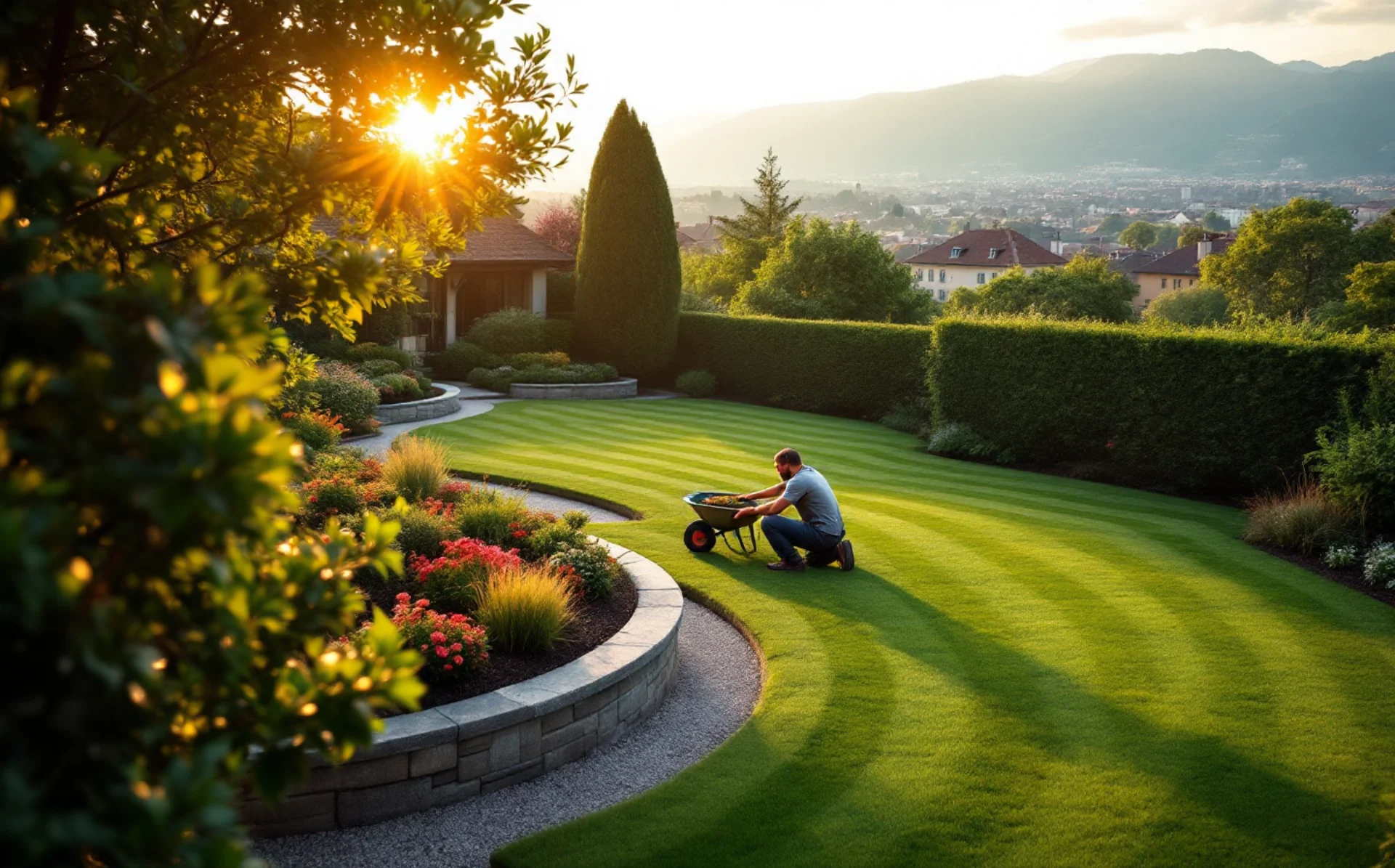
A landscaper in Vandœuvres most often works on large properties: designing a garden around a villa, laying out a driveway, fitting a gate, planting trees. Describe your project online: a qualified landscaper will get back to you within 24 hours, visit the site and provide a free, no-obligation quote.
The terrain in Vandœuvres: what to know before a project
Vandœuvres is a residential, countryside municipality on the left bank, which also includes the hamlets of Chougny and Pressy. The landscape is made up of large estates, villas surrounded by parkland, oaks and old trees, with meadows and fields between the properties.
This setting has practical consequences for a building site. Old trees mean the roots must be protected during works and the route of driveways thought through before any digging. Large plots call for an overall plan rather than a series of small pieces of work. At the edge of fields the bise wind is felt: exposure, hedges and the choice of planting are studied accordingly. As in much of the canton, the soil is often clay and holds water in winter, which matters for drainage and plant selection. During the visit, the landscaper looks at the terrain, the sunlight and the condition of the existing trees.
Landscaping projects in Vandœuvres
Estate garden creation
On a large plot, garden creation starts with a plan: living areas, views to preserve, circulation between the house and outbuildings. The aim is to work with the existing grounds, their trees and their vistas, rather than redoing everything. Coherent landscape design then links the spaces together.
Driveways and courtyards
On an estate, the driveway is the first impression of the property. Whether in gravel, paving stones or asphalt, it must carry vehicles, drain rainwater and work around the roots of large trees. The courtyard in front of the house deserves the same care: manoeuvring, parking and receiving visitors.
Gates and wicket gates
At the entrance to an estate, the gate and wicket gate set the tone. The choice of material, style and any motorisation is made in keeping with the house and driveway. Pillars and foundations need to be planned from the design of the entrance.
Discreet fencing at the edge of fields
Between a property and the neighbouring meadows, the aim is often a boundary that protects without closing off the landscape. A fence or metal trellis in a subdued colour, backed by a hedge or planting, blends into the setting while keeping animals out and securing the land.
Tree planting
In a municipality known for its old trees, planting is a long-term commitment. The landscaper chooses species according to the space available at maturity, the soil and exposure to wind, then plans staking and watering to help them establish. If existing trees get in the way of the project, pruning or felling is dealt with beforehand.
Terraces and the surroundings of the house
A timber or stone terrace extends the villa towards the garden. On a large estate, it is placed to enjoy the best exposure and the view, and sheltered from the wind if necessary.
Automatic irrigation for large grounds
A properly sized automatic irrigation system quickly becomes useful when planted areas are extensive, particularly in dry summers. It is ideally planned before planting, while the trenches are still open.
Suitable materials and plants
In a setting of parkland and fields, natural materials are the obvious choice: local stone for low walls and thresholds, timber for terraces and structures, stabilised gravel for driveways. Asphalt remains relevant for a busy access road, and metal for fences and gates, in discreet colours.
As for plants, the Lake Geneva climate, with its damp winters, sometimes dry summers and the bise, favours robust species: oaks, maples and lime trees for large specimens, mixed hedges of local species, and perennials and grasses for borders. The plants chosen must tolerate a often clay soil and find their place alongside existing trees.
Permits and neighbours
In Geneva, certain outdoor structures, such as a swimming pool, a fixed pergola, a carport, a wall or major earthworks, may require a building permit from the canton. Felling a tree requires authorisation from the cantonal Office for Agriculture and Nature (OCAN). The landscaper checks with you what applies to your project before starting. It is also helpful to inform your neighbours of a major project, especially along the property boundary.
Your project in four steps
- Online request: you describe your project and your land.
- Site visit: a qualified landscaper gets back to you within 24 hours and comes to Vandœuvres.
- Detailed free quote: you receive a clear proposal, with no obligation.
- Completion: the work proceeds according to the agreed schedule.
To get started, request a quote.
Landscaper in neighbouring municipalities
Our landscapers also work in Cologny, Choulex, Chêne-Bougeries and Collonge-Bellerive. See all our areas of operation.
Frequently asked questions
Can a landscaper work in grounds with old trees in Vandœuvres?
Yes, it is a common situation in the municipality. The landscaper identifies the trees to keep, protects their roots during the works and adapts the route of driveways or terraces. If felling is being considered, cantonal authorisation is required.
How should I lay out a driveway on a large estate?
The route is decided on site, taking into account the terrain, the trees and the drainage of water. The surface (gravel, paving stones or asphalt) depends on use and the look you want. The quote details each option.
What fencing should I choose at the edge of fields?
A simple metal fence, combined with a hedge or planting, provides an effective boundary that blends into the landscape. The landscaper advises you according to the height you want, security and the view to preserve.
Do I need a permit for my landscaping project?
It depends on the nature of the work. A wall, a swimming pool, a fixed pergola, a carport or major earthworks may require a building permit. The landscaper checks with you what applies before work begins.
When should I plant trees and create a garden?
Autumn and early spring are well suited to planting, when the soil is cool and moist. Design and structural work can start beforehand. The exact schedule is set with the landscaper during the visit.