
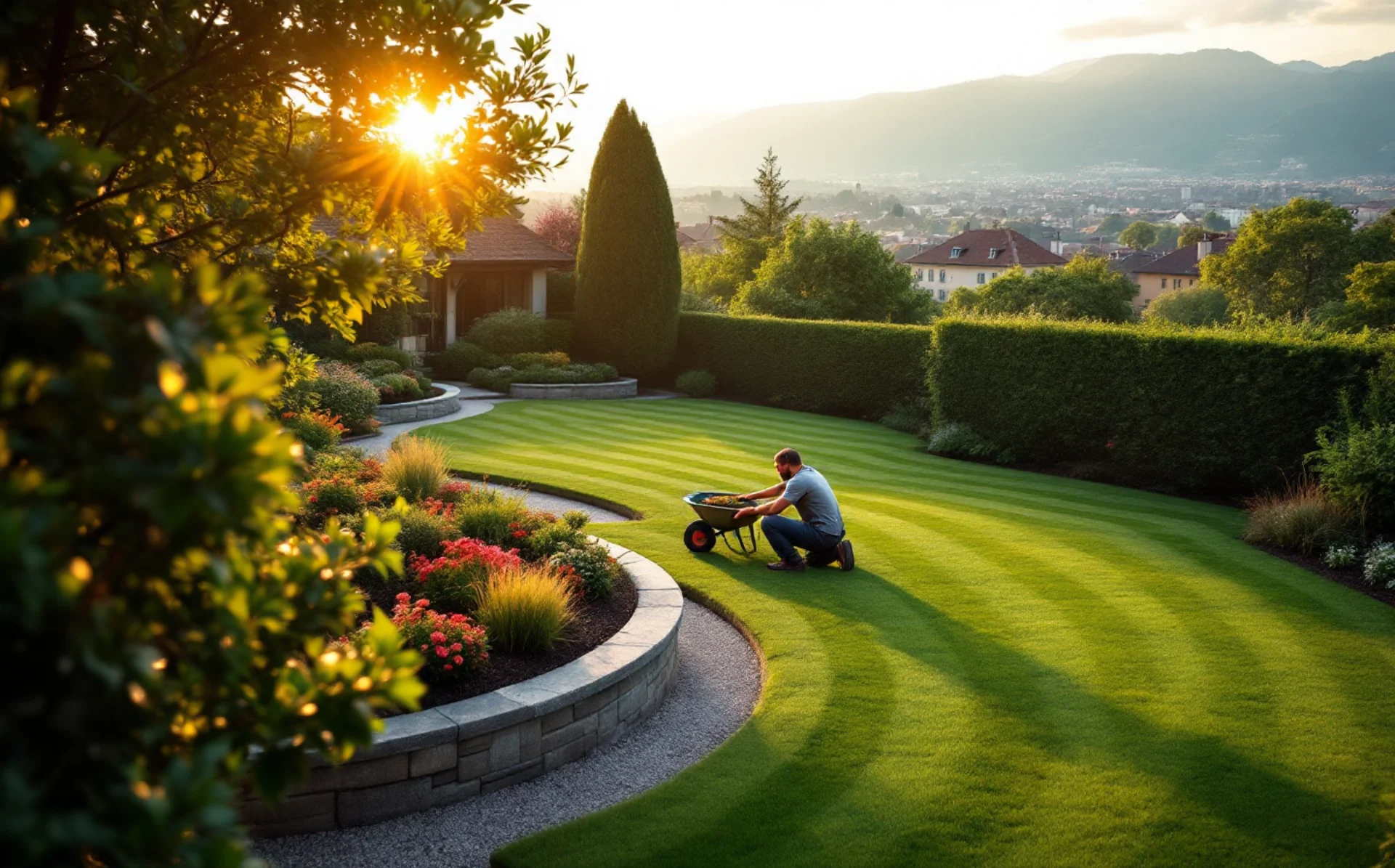
Taming slopes across Geneva canton
Much of Geneva canton sits on undulating terrain. Hillside gardens, tiered plots and embankments alongside driveways are everyday realities for property owners across the canton. Left unmanaged, sloping ground erodes, limits usable garden space and can even threaten structures downhill. A professionally built retaining wall or gabion system turns a problem slope into a design feature — and Mon-paysagiste.ch puts you in touch with qualified landscapers who can make it happen.
Retaining solutions available
Gabion walls are cages of galvanised or galfan-coated wire mesh filled with natural stone — limestone, granite, river pebbles or recycled aggregates. They are inherently permeable, which means water drains through rather than building up pressure behind the wall. Gabions suit heights from 0.5 to 4 metres and blend effortlessly into landscaped gardens.
Dry-stone walls are part of Switzerland’s heritage landscape. Built without mortar, they rely on the skill of the mason and the careful selection of each stone. They are beautiful, ecologically valuable (providing habitat for insects and lizards) and ideal for garden terracing up to about 1.5 metres.
Mortared natural-stone walls offer the visual warmth of stone with added structural strength. They are well suited to formal gardens and boundary walls where a polished finish is desired.
Reinforced-concrete walls handle the heaviest loads and the tallest heights. Where engineering demands it — deep cuts, road-side embankments or retaining walls above 3 metres — concrete is the proven solution. These projects typically require a structural engineer’s calculations and a building permit.
Precast interlocking blocks provide a fast, cost-effective alternative with a range of surface finishes that mimic natural stone.
Timber retaining walls using treated softwood sleepers or hardwood beams suit low walls (under 1 metre) in informal garden settings. They are cost-effective and blend naturally into planted landscapes.
The Mon-paysagiste.ch approach
Describe your project on Mon-paysagiste.ch and a qualified landscaper will contact you within 24 hours. Every project starts with a thorough site assessment: soil type, gradient, drainage patterns and the loads the wall must carry. In Geneva’s clay-heavy soils, hydrostatic pressure is a critical factor — especially during spring snowmelt and heavy autumn rains. Getting the drainage right is non-negotiable.
If your project also involves fencing, terrace construction or garden creation, you can discuss every element during the same site visit with the landscaper who contacts you.
Qualified landscapers prioritise ecological methods wherever possible: locally sourced stone, permeable gabion designs that support natural drainage and planting pockets that encourage biodiversity. The site visit and quote are free.
Stone options for gabion walls in Geneva
The fill stone you choose affects both the appearance and cost of your gabion wall:
- Local Jura limestone: the most popular choice in the Geneva region, it blends naturally with the landscape and is widely available from quarries within a short transport distance, reducing both cost and carbon footprint
- Alpine granite: grey, durable and weather-resistant, it suits modern and minimalist garden designs
- River pebbles: rounded stones in mixed earth tones create a softer, more natural appearance — ideal for garden borders and decorative walls
- Recycled crushed concrete: an economical and environmentally responsible option for structural gabions that will be planted over or hidden behind vegetation
The wire mesh cages themselves are available in galvanised steel (zinc-coated) or galfan-coated wire for enhanced corrosion resistance in Geneva’s humid climate. For walls in prominent positions, qualified landscapers can use stainless steel mesh with a lifespan exceeding 100 years.
How the project works
1. Describe your project — Describe the slope, the approximate wall length and height, and any specific goals (terraced planting beds, driveway retention, boundary feature). Photos or a short video of the site help the landscaper prepare.
2. Free site visit and quote — A qualified landscaper evaluates the terrain, discusses material options and delivers a transparent, itemised quote with no obligation.
3. Construction — The landscaper excavates, prepares foundations, builds the wall and handles drainage, backfill and site clean-up, with rigorous quality control at every stage.
Drainage: the critical factor on Geneva’s clay soils
Retaining wall failures are almost always caused by inadequate drainage. In Geneva’s clay-limestone ground, water pressure behind a wall can build rapidly during autumn rains and spring snowmelt. A sound drainage strategy includes:
- Geotextile membrane: placed between the backfill and the native soil to prevent clay from clogging drainage paths
- Drainage gravel backfill: a minimum 30 cm layer of clean gravel behind the wall face allows water to flow downward freely
- Perforated drainage pipe: installed at the base of the wall to collect and redirect water to a safe discharge point
- Weep holes or permeable construction: gabion walls drain naturally through their stone fill; for concrete walls, weep holes are installed at regular intervals
These measures are not optional extras — they are essential to every retaining wall built in the Geneva region.
Indicative pricing
| Wall type | Approximate cost (CHF per m2, supplied and installed) |
|---|---|
| Gabion wall (1 to 2 m high) | 200 — 380 |
| Gabion wall (2 to 4 m high) | 320 — 600 |
| Dry-stone wall | 300 — 680 |
| Mortared natural-stone wall | 400 — 900 |
| Reinforced-concrete wall (with formwork) | 450 — 1,100 |
| Precast interlocking block wall | 230 — 520 |
As a guide, a gabion wall 10 metres long and 1.5 metres high typically costs CHF 3,000 to CHF 5,700 installed. Fill stone prices vary depending on whether you choose local limestone or hand-selected decorative pebbles.
Frequently asked questions
When is a building permit required?
In Geneva canton, retaining walls above approximately 1 to 1.2 metres generally require a permit. Larger structures may also need plans certified by a civil engineer. The landscaper who visits your site can advise you on the applicable rules and the documentation required.
How long do gabion walls last?
A gabion wall built with galfan-coated mesh and quality stone fill has a life expectancy of 50 to 100 years. The stone itself is virtually indestructible, and the mesh can be upgraded to stainless steel for even greater longevity.
Are gabions environmentally friendly?
Very much so. They are fully permeable, which prevents additional surface run-off. The gaps between stones create micro-habitats for insects, small reptiles and plant roots. Over time, vegetation colonises the wall naturally, further enhancing biodiversity — an approach that fits sustainable gardening.
Can gabions be built on clay soil?
Yes, but clay demands extra attention to drainage. A compacted gravel foundation beneath the first course is typically installed, with drainage pipes positioned behind the wall to channel water away. A professional site assessment determines the exact preparation needed.
Do retaining walls need maintenance?
Gabion and stone walls require very little upkeep. An annual visual check of the mesh condition and drainage function is sufficient. Concrete walls should be inspected for cracks after severe frost seasons. Prompt minor repairs extend the life of any retaining structure significantly.
When is the best season to build a retaining wall in Geneva?
Construction is possible year-round, but the optimal period is April through November when soil conditions are most workable. Excavation in Geneva’s clay soils is easier when the ground is not saturated by winter rain. For walls requiring a building permit, it is best to start the application process 8 to 12 weeks before the desired construction start date.
Why choose Mon-paysagiste.ch for retaining walls and gabions
- Engineering expertise — qualified landscapers assess soil conditions, drainage requirements and structural loads before any construction begins, ensuring long-term stability on Geneva’s clay-heavy terrain
- Locally sourced materials — Jura limestone and Alpine granite sourced from regional quarries for authenticity and reduced transport impact
- Ecological design — gabions double as biodiversity features, with planting pockets and habitat gaps for insects and small reptiles
- Complete garden projects — retaining walls can be planned together with fencing, terrace construction and garden creation in a single request