
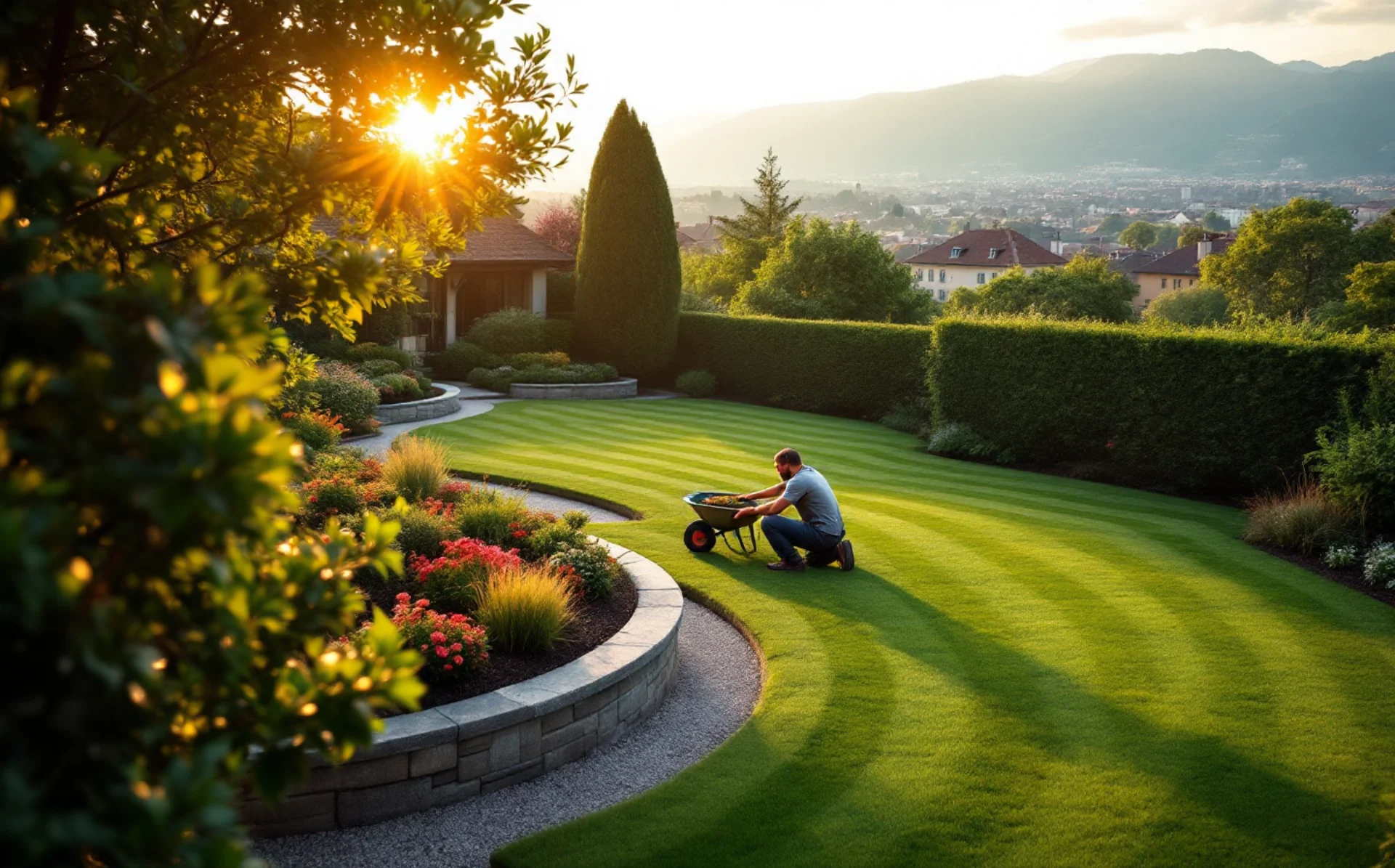
A landscaper in Satigny designs and builds outdoor spaces that respect a distinctive area: the Mandement, with its vineyards, estates and hamlets. Earthworks on a sloping plot, retaining walls, courtyards and driveways, a carport or a new garden: every project starts from the site itself. Describe yours online and a qualified landscaper will contact you within 24 hours, visit the property and provide a free, no-obligation quote.
The land in Satigny: what to know before a project
Satigny is the largest wine-growing municipality in Switzerland. Its landscape combines vineyards, estates, winegrowers’ houses and villas with gardens, spread between the village and hamlets such as Peissy, Bourdigny and Choully. This variety of properties leads to very different projects: an estate courtyard is not treated like a villa garden.
The terrain plays a central role. In the Mandement, many plots are sloping, sometimes steeply, so you need to think about retaining structures, rainwater runoff and vehicle access before drawing anything. Geneva soils are often clay-rich: they hold water in winter, crack in summer and need careful drainage behind walls and beneath surfaces that carry traffic.
The climate is that of the Lake Geneva basin, with a bise wind that can be sharp and summers that are sometimes dry. On open ground among the vines, exposure to wind and sun is strong: it affects where to put a terrace and whether to choose a windbreak hedge or a pergola. A site visit makes it possible to read these constraints before any pricing.
Landscaping projects in Satigny
Landscaping sloping plots
A sloping plot is best enhanced by dividing it into levels, creating comfortable access and controlling water. Landscape design begins with a survey of the land, then defines levels, paths, planted areas and living spaces. In Satigny, where many plots follow the relief of the Mandement, this is often the key to making a garden genuinely usable.
A garden creation project on a sloping plot can also take advantage of the view and the opening onto the vineyard, orienting living areas where the light and scenery are at their best.
Retaining walls and gabions
When the slope becomes too steep, a retaining wall holds back the soil and creates usable flat ground. Gabions and retaining walls suit this setting well: they let water pass through, blend into wine-growing landscapes with their exposed stone and cope well with clay soils when drainage is provided.
The sizing depends on the height to be retained, the nature of the soil and the load uphill. The landscaper checks it on site before proposing a solution, and tells you if a permit may be required.
Courtyards and driveways
Properties in Satigny include many courtyards, estate entrances and access drives, often used by vehicles or farm machinery. Depending on use, you might choose asphalt or bituminous paving, stabilised gravel or a mix of materials to break up large expanses.
Preparing the sub-base and managing runoff matter as much as the finish: on a sloping plot, a poorly drained driveway deteriorates quickly.
Carports and vehicle shelters
In a hamlet or an isolated property, a carport or car shelter protects vehicles from rain, sun and hail without adding bulk to the existing building. Its timber or metal structure suits a winegrower’s house as well as a contemporary villa.
The siting is worked out with the profile of the land and the access to the road. As a fixed structure may require a permit, the landscaper helps you check whether one is needed during the visit.
Timber or stone terraces
A timber or stone terrace extends the house into the garden. In Satigny, it benefits from being oriented to the sun and sheltered from the bise by a hedge, a low wall or a screen. On a sloping plot, it often rests on a masonry platform or a retaining wall.
Fences, gates and access
Marking out a property, securing a garden or defining the entrance to an estate calls for well-chosen fencing and trellis and a gate or wicket gate in keeping with the building. The slope sometimes calls for bespoke solutions, such as stepped fences or gates with an adapted hinge axis.
Suitable materials and plants
In a wine-growing setting, natural stone and gabions filled with local stone, or stone of a similar colour, blend naturally into the landscape. Timber suits terraces, pergolas and carports; chosen in a durable species or treated for outdoor use, it ages well in the Geneva climate. Stabilised gravel provides a permeable, understated surface for driveways, while asphalt remains the most robust solution for heavily used areas. Metal is used for fences, gates and slim structures.
As for plants, favour species that tolerate dry summers and clay soil: hardy perennials and grasses, cold-resistant Mediterranean shrubs, fruit trees and mixed country hedges. On banks, ground-cover plants and strong-rooted shrubs help hold the soil. A well-adjusted automatic irrigation system limits water waste during dry spells.
Permits and neighbours
In Geneva, some outdoor structures may need a cantonal building permit: a pool, a fixed pergola, a carport, a wall or major earthworks. Felling a tree requires authorisation from the cantonal Office for Agriculture and Nature (OCAN). The landscaper checks with you what applies to your project before work begins.
Neighbours also deserve attention: a wall or fence on a boundary, earthworks that change the flow of water or a hedge planted close to neighbouring land are best discussed in advance. For trees to be removed or reduced, see tree pruning and removal.
Your project in four steps
- Online request: you describe your project and your plot in a few lines.
- Site visit: a qualified landscaper visits you, observes the terrain, soil and exposure, and discusses your wishes.
- Detailed free quote: you receive a clear proposal, with no obligation.
- Construction: the work proceeds according to the agreed schedule.
To get started, you can request a quote right now.
Landscapers in neighbouring communes
Have a project near Satigny? Find a landscaper in Dardagny, Meyrin or Vernier, and see all our service areas.
Frequently asked questions
Can a sloping plot be landscaped in Satigny?
Yes, it is one of the most common cases in the Mandement. The plot is divided into levels, the soil is held back with walls or gabions and drainage is planned. The site visit makes it possible to choose the solution suited to the slope and the soil.
Does a retaining wall require a permit?
It depends on its height, its position and the nature of the work. In Geneva, some walls and earthworks require a cantonal building permit. The landscaper checks with you what applies before pricing the project.
Are gabions suitable for a garden near the vineyards?
Yes, their exposed stone blends well into a wine-growing landscape. They let water through, which helps on clay soil, and are easy to plant at the base or top. The choice of stone and cage size depends on the height to be retained.
What surface should I choose for a courtyard or estate driveway?
For regular vehicle traffic, asphalt is the most durable. Stabilised gravel suits lighter use and lets water soak in. The sub-base and drainage remain decisive, especially on a slope.
Do I need a permit to install a carport?
A carport is a fixed structure: it may need a cantonal building permit depending on its location and dimensions. The landscaper helps you check this during the visit, before the quote is finalised.