
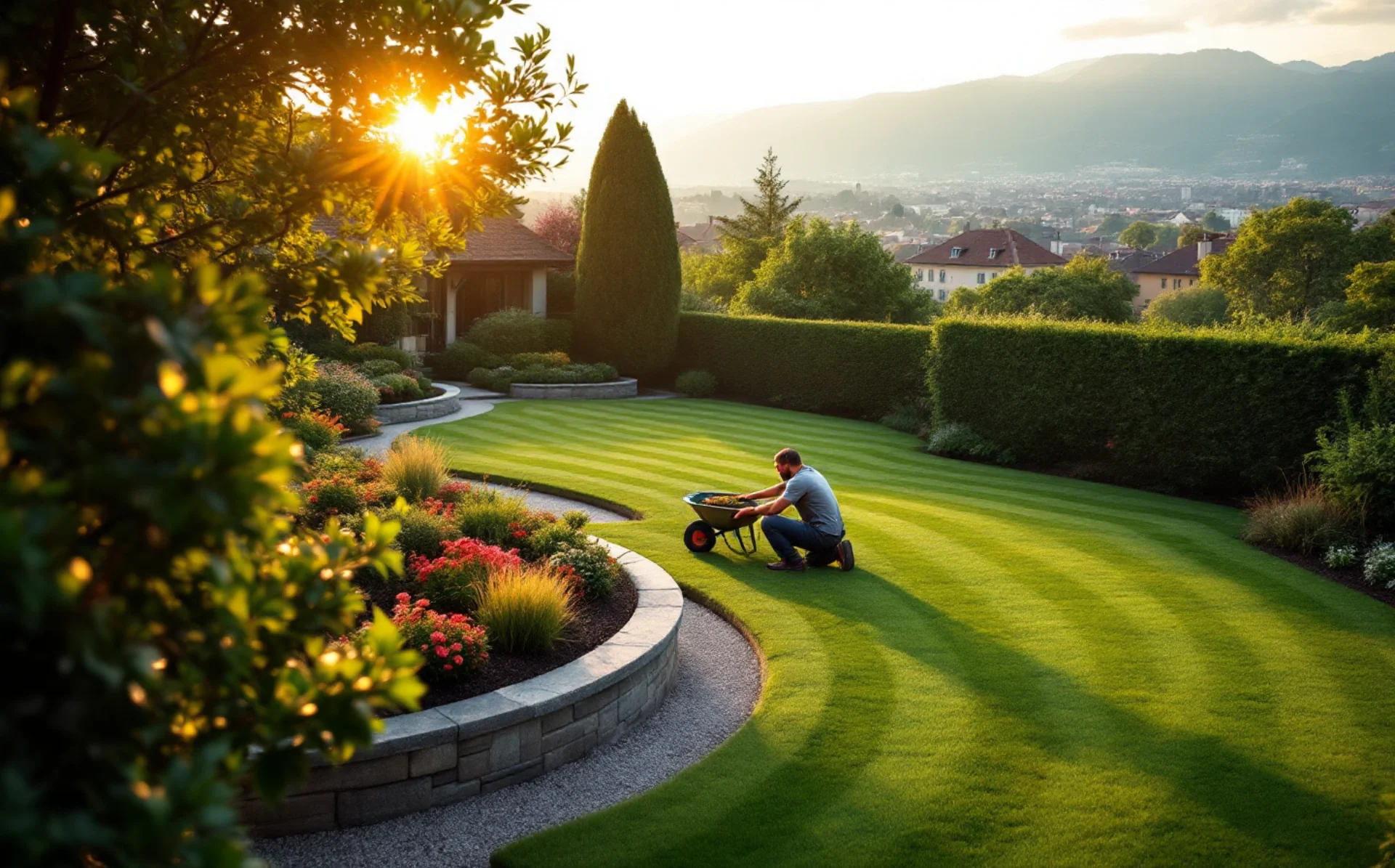
Sharp lines, healthy growth — hedge care done right
Hedges serve many purposes in Geneva’s gardens: they define boundaries, shield you from neighbours’ views, block wind, and provide habitat for birds and insects. But a neglected hedge quickly becomes an eyesore — or worse, a source of conflict with neighbours. Mon-paysagiste.ch, the gardening branch of PluriServices Sàrl, delivers precise, species-appropriate hedge trimming across Geneva and Western Switzerland.
What we offer
Not all hedges are equal, and neither is our approach. We adapt our technique to the species, age, and condition of your hedge:
- Regular maintenance trimming — clean cuts one to three times per year to preserve shape, density, and health
- Architectural shaping — creating formal geometric profiles or sculpted forms for ornamental hedges
- Rejuvenation cutting — drastic but controlled reduction of overgrown hedges to stimulate fresh growth from the base (species permitting)
- Hedge planting and establishment — selecting, planting, and training new hedges, with species advice based on your goals (privacy, aesthetics, wildlife value)
- Hedge removal — complete extraction including root systems when a hedge must be replaced or a boundary redesigned
We handle every common Geneva hedge species: thuja, laurel, hornbeam, beech, privet, photinia, yew, box, and mixed native hedges.
Geneva-specific considerations
Hedge management in Geneva canton involves specific rules that many property owners are unaware of:
- Boundary distances: the canton requires hedges to be planted at least 50 cm from the property line for hedges up to 2 m, and further for taller specimens. Violations can result in forced removal.
- Maximum height: some Geneva communes impose height limits for hedges along streets and at intersections for visibility reasons.
- Bird nesting protection: Swiss federal law prohibits severe hedge cutting between 1 March and 30 September to protect nesting birds. Light maintenance trimming remains permitted during this period.
Our gardeners know these regulations and ensure every intervention is fully compliant, sparing you potential disputes or fines.
The Mon-paysagiste.ch difference
Artisan precision, not factory speed. We take the time to achieve clean, straight lines and a finish that looks sharp for weeks, not days. Our gardeners use commercial-grade equipment maintained to professional standards.
Ecological awareness. We time our cuts to minimize stress on the plants and avoid disrupting nesting wildlife. Trimmings are composted locally, not sent to landfill.
Part of PluriServices Sàrl. Combining hedge trimming with other property services — garden maintenance, exterior cleaning, or seasonal care — is seamless when everything runs through one company.
Seasonal hedge care calendar for Geneva
Timing hedge work correctly in the Geneva region ensures healthy growth and legal compliance:
- March (before 1 March nesting ban ends): Last opportunity for heavy rejuvenation cuts on deciduous hedges before bird nesting season begins
- May–June: First maintenance trim of the year for fast-growing species (laurel, privet, thuja). Hedges typically grow 30–60 cm in this period around Lake Geneva
- July: Second trim for vigorous growers; light shaping for formal hedges
- September: Final trim of the season, allowing plants to harden off before winter. Ideal time to plant new hedges in Geneva, as autumn moisture helps root establishment
- November–February: Rejuvenation pruning of deciduous hedges (hornbeam, beech) during dormancy. No nesting restrictions apply
Native hedge alternatives
We increasingly recommend mixed native hedges for Geneva properties. Species such as hawthorn (Crataegus monogyna), field maple (Acer campestre), dogwood (Cornus sanguinea) and spindle (Euonymus europaeus) provide excellent screening, support local wildlife and require less frequent trimming than monoculture hedges. They are also well adapted to Geneva’s clay-limestone soils.
How to proceed
- Contact us — describe your hedge (species if known, approximate length and height, location). We respond within 24 hours.
- Free assessment — a gardener visits, evaluates the hedge’s condition and any regulatory factors, and provides a written quote at no cost.
- Expert trimming — we carry out the work, collect all waste, and leave your boundary looking its best.
Hedge species guide for Geneva gardens
Understanding your hedge species helps us deliver the best results:
- Cherry laurel (Prunus laurocerasus): the most common evergreen hedge in Geneva. Fast-growing (40–60 cm/year), needs 2–3 trims annually. Best cut with secateurs or reciprocating trimmers to avoid shredding the large leaves
- Thuja (Thuja occidentalis/plicata): dense, evergreen and relatively fast-growing. Must be trimmed regularly — once it becomes bare inside, conifers rarely regenerate from old wood
- Hornbeam (Carpinus betulus): a deciduous hedge that retains bronze leaves through winter when trimmed. Tolerates heavy pruning and regenerates well. One to two trims per year
- Yew (Taxus baccata): slow-growing, dense and extremely long-lived. Tolerates shade and hard pruning. One trim per year is usually sufficient
- Photinia (Photinia x fraseri): prized for its red new growth. Semi-evergreen in Geneva’s climate, needing 2 trims per year and a sheltered position
Pricing overview
| Service | Indicative price (CHF) |
|---|---|
| Maintenance trim (hedge under 1.5 m) | 3.– to 5.– / linear metre |
| Maintenance trim (hedge 1.5–3 m) | 5.– to 8.– / linear metre |
| Rejuvenation pruning | 8.– to 15.– / linear metre |
| Hedge removal (including roots) | 12.– to 25.– / linear metre |
| New hedge planting (supply + plant) | 25.– to 70.– / linear metre |
| Annual contract (2–3 visits) | 200.– to 530.– depending on length |
| Green waste disposal | Included or 50.– to 100.– |
Prices include VAT. Free detailed quote after on-site visit.
Frequently asked questions
How many times per year should my hedge be trimmed?
It depends entirely on the species and the look you want. Fast growers like cherry laurel and thuja need two to three trims annually (typically May, July, and September). Slower species such as yew, hornbeam, or beech usually require just one or two cuts. We recommend the optimal schedule during our initial assessment.
My hedge has become bare at the bottom — is it salvageable?
Often, yes — but it depends on the species. Hornbeam, beech, and yew regenerate well from old wood and respond to phased rejuvenation pruning over two to three seasons. Thuja and most conifers, however, will not regrow from bare brown wood. In those cases, we may recommend partial replacement or underplanting with shade-tolerant species. A site visit allows us to give you an honest prognosis.
Can you trim hedges along roads and public paths?
Yes. We are equipped for roadside work and follow Swiss traffic safety requirements, including signage and protective barriers where necessary. For hedges bordering cantonal roads in Geneva, specific height and clearance rules apply — we ensure compliance as part of the service.
What happens to the trimmings?
All green waste is collected and either composted at certified local facilities or chipped on-site for use as mulch in your garden. We never leave debris behind, and our disposal methods comply fully with Geneva’s cantonal waste regulations.
Do you offer combined packages with other garden services?
Absolutely. Many clients pair hedge trimming with lawn mowing, tree pruning, or full garden maintenance contracts. Bundled services benefit from coordinated scheduling and typically offer better value than booking each service separately.
What equipment do you use for hedge trimming?
We use professional Stihl and Husqvarna hedge trimmers, including telescopic models for tall hedges up to 4 metres without the need for scaffolding. Blades are sharpened before every job to produce clean cuts that heal quickly, reducing the risk of fungal infection — particularly important for laurel hedges in Geneva’s humid lakeside climate.
Why choose Mon-paysagiste.ch for hedge care
- Species-specific expertise — we adapt cutting technique and schedule to each hedge type, from formal yew topiary to free-growing native screens
- Regulatory compliance — we work within Geneva’s boundary distance rules, height limits and bird nesting protection periods
- Clean, complete service — all trimmings collected and composted; your boundary is left sharp and tidy
- Integrated property care — as part of PluriServices Sàrl, hedge trimming coordinates seamlessly with fencing, garden maintenance and other outdoor services