
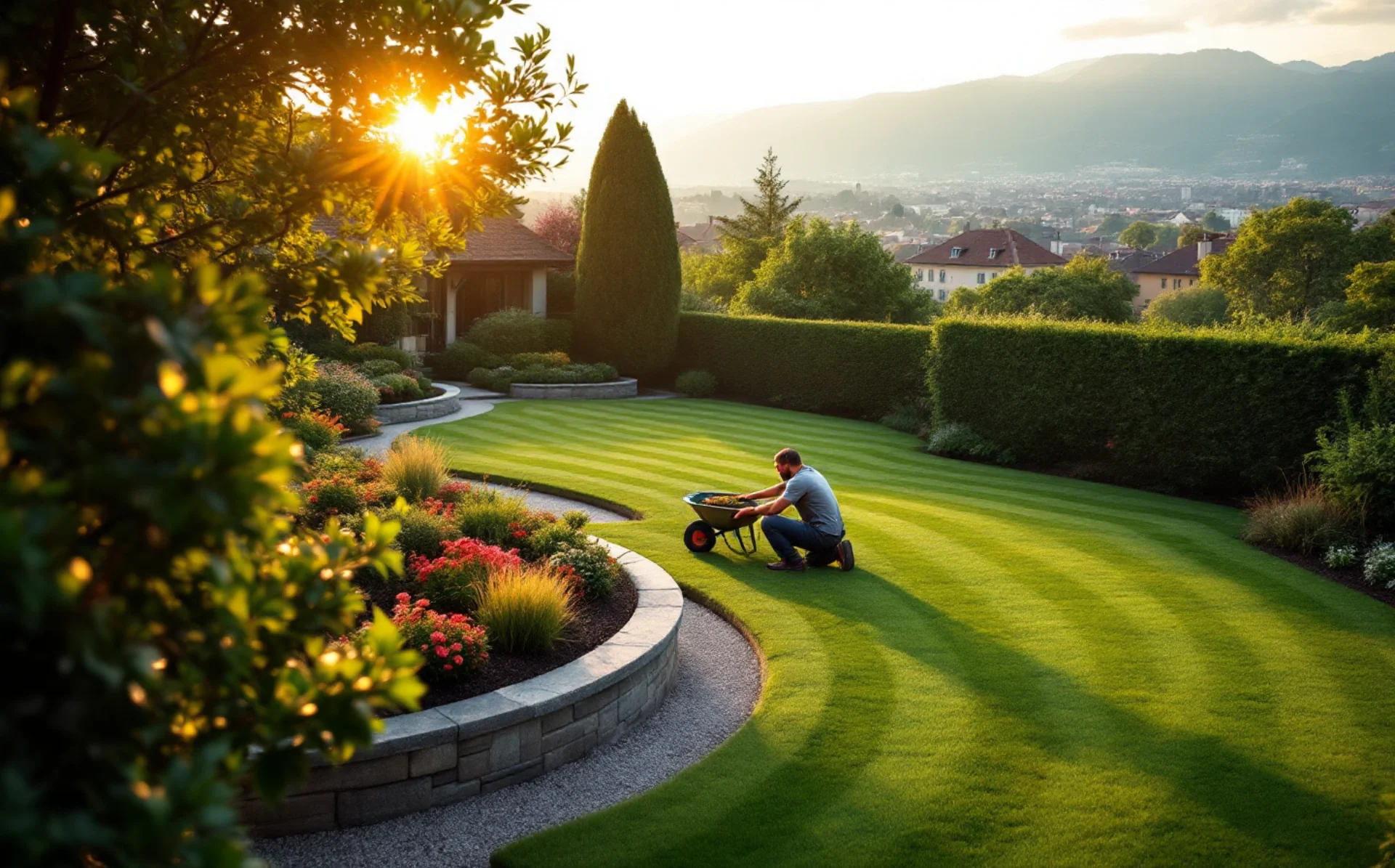
Water smarter, not harder
Summers around Lake Geneva have grown hotter and drier over the past decade, putting real pressure on lawns, borders and newly planted gardens. Hand-watering wastes time, delivers uneven coverage and typically uses far more water than necessary. A professionally designed automatic irrigation system solves all three problems at once — and Mon-paysagiste.ch, the gardening branch of PluriServices Sarl, is here to design, install and maintain it for you.
How an automatic irrigation system works
At its core, the system is a network of buried polyethylene pipes connected to your water supply and managed by a programmable controller. Different zones of your garden receive the right type and amount of water at the optimal time of day.
Pop-up sprinklers rise from the ground during watering and retract flush with the lawn afterwards. Spray heads suit compact areas, while rotors cover larger stretches up to 15 metres in radius — perfect for the generous lawns found across Geneva canton.
Drip irrigation delivers water directly to plant roots through low-flow emitters. It is the most water-efficient option available, ideal for hedges, flower beds, vegetable patches and newly created gardens.
Smart controllers connect via Wi-Fi and adjust schedules automatically based on real-time weather data and soil moisture readings. Many integrate with smartphone apps, letting you monitor consumption from anywhere.
Pairing these technologies across different zones is where professional design makes the difference.
Brands and components we trust
We design systems using industry-leading components for reliability and long-term parts availability:
- Hunter Industries: MP Rotator nozzles for uniform water distribution, Pro-Spray pop-up bodies and PGJ rotors for medium lawns. Hunter’s Hydrawise smart controller offers Wi-Fi connectivity and predictive watering based on local weather stations
- Rain Bird: ESP-TM2 and ESP-Me3 controllers, 5000 Series rotors for large lawns, and XFS subsurface dripline for hedges and borders
- Netafim: professional-grade drip irrigation systems, particularly for vegetable gardens and precision bed watering
- Gardena: the Gardena smart system suits smaller Geneva gardens where a simpler, well-integrated solution is preferred
All components we install carry manufacturer warranties and are readily available from Swiss distributors for future maintenance or expansion.
Why choose Mon-paysagiste.ch
Our approach is rooted in ecology and local expertise. We understand Geneva’s clay-heavy soils, its municipal water regulations and the freeze-thaw cycles that can destroy poorly installed systems. Every project starts with a hydraulic study — we measure your water pressure, calculate flow rates and map out zones to guarantee uniform coverage with zero waste.
As part of PluriServices Sarl, we coordinate seamlessly with other trades. If your project also involves landscape design, lawn care or terrace construction, one team handles everything. You get a single quote, a single timeline and a single point of contact.
We respond to every enquiry within 24 hours, and the on-site survey is always free.
Geneva water usage and sustainability
Water conservation is increasingly important in the Geneva region. Municipal water in Geneva is supplied by SIG (Services Industriels de Genève) and comes primarily from Lake Geneva — a high-quality source, but one whose cost continues to rise. An efficient irrigation system helps manage consumption:
- Smart scheduling: watering between 4 AM and 8 AM reduces evaporation by up to 30 % compared with midday irrigation
- Zone-based design: lawns, hedges, flower beds and vegetable gardens each receive precisely the amount of water they need — no more, no less
- Rain sensors and soil moisture probes: these devices pause irrigation when natural rainfall is sufficient, preventing waste
- Rainwater harvesting: connecting to a buried cistern (2,000–10,000 litres) reduces reliance on municipal water and lowers your SIG bill. Geneva offers favourable conditions for rainwater collection given its average annual rainfall of approximately 1,000 mm
Our three-step process
1. Describe your garden — Share details about the area, the zones you want irrigated and any preferences (rainwater harvesting, smart control, drip-only beds). An aerial photo or sketch helps enormously.
2. Site visit and free quote — Our technician assesses terrain, soil type and water supply, then delivers a detailed, no-obligation quote with a full layout plan.
3. Installation and handover — We trench, lay pipes, install sprinklers and programme your controller. Before we leave, we walk you through every function so you are fully in control.
System maintenance and winterisation
An irrigation system in Geneva requires seasonal attention to perform reliably year after year:
- Spring start-up (March–April): we reactivate the system, check all sprinkler heads for damage, verify controller programming and adjust zone timings for the new growing season
- Mid-season check (July): a summer inspection ensures nozzles are not clogged, drip emitters are flowing correctly and the controller is responding to weather data
- Winterisation (late October): the entire pipe network is purged with compressed air at controlled pressure to remove all water before the first frost. This step is essential in Geneva, where overnight temperatures can drop below −5 °C from November onwards
- Repairs and upgrades: broken sprinkler heads, leaking fittings or controller malfunctions are addressed promptly. We keep common Hunter and Rain Bird parts in stock for fast turnaround
Indicative pricing
| Service | Approximate cost (CHF, supplied and installed) |
|---|---|
| Lawn sprinkler system — up to 100 m2 | 2,000 — 3,500 |
| Lawn sprinkler system — up to 300 m2 | 3,500 — 5,000 |
| Lawn sprinkler system — up to 500 m2 | 5,000 — 7,500 |
| Drip irrigation for hedges and borders (50 lm) | 650 — 1,550 |
| Smart Wi-Fi controller | 130 — 390 |
| Rain sensor or soil-moisture probe | 65 — 200 |
| Annual maintenance (winterisation + spring start-up) | 180 — 390 |
Rocky or steeply sloped terrain increases trenching costs. Connecting to a rainwater harvesting tank (buried cistern plus pump) adds CHF 2,500 to 6,000 but pays for itself through reduced water bills — an increasingly attractive option given Geneva’s rising utility rates.
Frequently asked questions
When should I install an irrigation system?
The best windows are spring (March to May) and early autumn (September to October), when the soil is workable and your garden is not under drought stress. Winter planning is also smart — availability is better and you can often secure more competitive pricing ahead of the busy season.
Will installation damage my existing lawn?
Trenches are narrow (10—15 cm) and backfilled immediately. Visible lines fade within two to four weeks as the grass regrows. Our team reseeds any affected strips so recovery is as fast as possible.
Is winterisation really necessary in Geneva?
Absolutely. Even in Geneva’s relatively mild winters, overnight temperatures regularly drop below zero from November through March. Water left in the pipes can freeze and crack fittings. We purge the entire system with compressed air before the first frost, typically in late October, and restart it in spring — both included in our annual maintenance contract.
How much water does an automatic system save?
Compared with manual hose watering, a calibrated system reduces consumption by 20 to 50 percent. Smart controllers with rain sensors push savings even further by skipping cycles when rain is forecast or when soil moisture is already adequate.
Can the system use collected rainwater?
Yes. We regularly install systems connected to buried rainwater tanks ranging from 2,000 to 10,000 litres. The setup includes a submersible pump and an automatic switchover to mains water when the tank runs dry. It is an ecological and economical choice that aligns perfectly with Swiss sustainability goals.
How does Geneva’s clay soil affect irrigation design?
Geneva’s clay-limestone soil absorbs water slowly. If sprinklers deliver water faster than the soil can absorb it, you get runoff and waste. We address this by programming cycle-and-soak schedules — shorter watering periods repeated two or three times with pauses in between — so every drop penetrates to the root zone. Drip irrigation is particularly effective on clay soils because it delivers water gradually.
Why choose Mon-paysagiste.ch for irrigation
- Hydraulic precision — every system begins with a pressure and flow-rate study to guarantee uniform coverage across all zones
- Premium components — we install Hunter, Rain Bird and Netafim products backed by manufacturer warranties and readily available in Switzerland
- Geneva climate expertise — we design for local conditions including clay soils, hot summers, freeze-thaw cycles and municipal water regulations
- Full-service support — installation, annual winterisation, spring start-up and ongoing adjustments managed by the same team that built your system